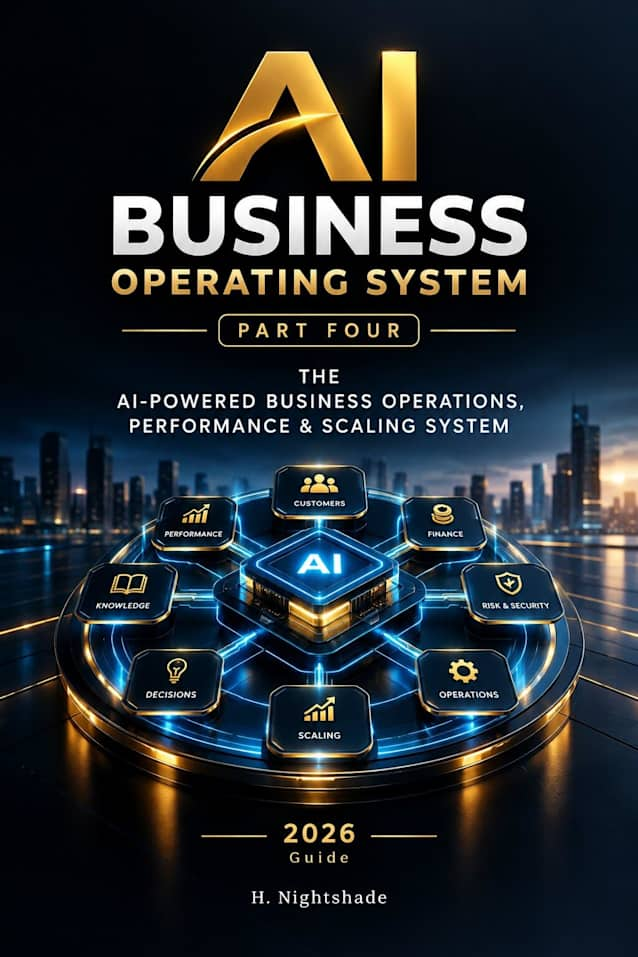
AI BUSINESS OPERATING SYSTEM — PART FOUR—: THE AI-POWERED BUSINESS OPERATIONS, PERFORMANCE & SCALING SYSTEM —2026 Guide— (The Problem Solver Series Book 26)
About
This book focuses on the systems that help a business understand its customers, manage financial information, identify risks, make better-informed decisions, organize business knowledge, improve continuously, measure performance, and prepare for growth.
Instead of treating AI as a collection of individual tools, this guide shows how AI can become part of the way a business operates.
Inside this book, you will explore how to build:
• An AI Customer Operating System for organizing customer information, understanding customer needs, improving communication, and creating more consistent customer experiences.
• An AI Financial Operating System for organizing financial information, monitoring business numbers, improving financial visibility, and supporting better financial decisions.
• An AI Risk, Security & Compliance Operating System for identifying operational risks, protecting important information, creating stronger controls, and building safer business processes.
• An AI Decision-Making Operating System for turning business information into structured decisions instead of relying only on assumptions or scattered information.
• An AI Knowledge Management Operating System for capturing business knowledge, organizing experience, documenting lessons, creating reusable procedures, and building an AI-assisted business memory.
• An AI Continuous Improvement Operating System for turning feedback, results, mistakes, and lessons into ongoing improvements.
• An AI Business Performance Operating System for tracking important business activities, identifying performance patterns, and creating a clearer picture of what is actually happening inside the business.
• An AI Scaling Operating System for preparing processes, people, information, and technology for growth without allowing complexity to take over the business.
• A Complete AI Business Operating System that connects these systems into one practical framework.
This is not about adding AI to every task simply because AI exists.
It is about understanding where AI can create useful leverage.
The book focuses on practical systems, workflows, processes, questions, checklists, and implementation ideas that ordinary business owners can adapt to their own circumstances.
You will also learn how to think about AI as part of a larger business architecture rather than treating it as a collection of disconnected prompts.
A strong AI business system should help answer important questions:
Where are our customers struggling?
What is happening financially?
What risks are we carrying?
What information should influence our next decision?
What have we already learned?
What should we improve?
How are we performing?
What needs to change before we scale?
And ultimately:
How can all of these systems work together?
AI does not replace the responsibility of business owners and managers to verify information, protect sensitive data, comply with applicable requirements, and make important decisions.
Instead, AI can help organize information, reduce repetitive work, surface patterns, document knowledge, support analysis, and make important business information easier to access.
The goal is a business that can operate with greater visibility, consistency, and adaptability.
Whether you are building a small business, running an online operation, managing a service business, developing digital products, or preparing an established company for growth, the principles in this book can be adapted to your situation.
You do not need to implement everything at once.
Start with one system.
Build it.
Test it.
Learn from the results.
Improve it.
Then connect it to the next system.
That is how an AI Business Operating System becomes practical.